— And Why It's Worth Every Penny
Executive Summary
Customer churn rarely happens because a product lacks features — it happens because customers don’t know how to unlock value. A Customer Education University closes that gap.
This article outlines why structured education is one of the highest-ROI investments a SaaS company can make and provides a step-by-step framework for building one. When done well, a university reduces churn, accelerates time to value, increases product adoption, drives expansion revenue, strengthens partner ecosystems, and turns customers into brand advocates.
The framework covers defining strategic objectives, designing scalable learning paths, selecting the right LMS, building the proper team, structuring certifications, pricing education tiers, and launching with executive alignment. Real-world case studies — including ClickUp University (120,000+ learners, 73% engagement lift, significant churn reduction) and Planview AdaptiveWork Masterclasses — demonstrate measurable impact across enterprise environments.
A Customer University is not a content library. It is a revenue, retention, and brand strategy. When built intentionally, it transforms education from a support function into a scalable growth engine.
Here's a scenario that plays out at SaaS companies every day: A customer signs up, pokes around the product for a few days, can't quite figure out how to get value from it — and quietly cancels. No angry email. No support ticket. Just gone.
Now multiply that by hundreds or thousands of customers, and you start to see the real cost of leaving education to chance.
The good news? There's a proven solution — and it's not another onboarding email sequence or a longer help center article. It's a Customer Education University: a structured, intentional learning ecosystem designed to turn your users into confident, successful, loyal advocates of your product.
Lauren has built this from the ground up. Twice. And the results speak for themselves — 120,000+ active learners, 73% increases in engagement, churn reductions of 500%, and content used by 59 of the Fortune 100. In this article, Lauren is going to walk you through exactly how it's done: why it matters, what it produces, and the step-by-step pathway to building one that actually works.
Part 1: Why Customer Education Is Critical for SaaS Companies
Let's start with the uncomfortable truth: most SaaS companies spend enormous amounts of money acquiring customers and almost nothing teaching them how to succeed with the product once they've signed up.
The assumption seems to be that a good product sells itself. It doesn't. A good product that people know how to use sells itself.
The gap between signing up and getting genuine value from a product — what growth experts call "time to value" — is where churn is born. Customers don't leave because your product is bad. They leave because they couldn't figure out how to make it work for them, or because a competitor made it feel easier.
Education collapses that gap. When your customers understand what your product can do and how to use it effectively, three things happen simultaneously. First, they start seeing results faster, which creates an immediate emotional connection to your brand. Second, they stop relying on your support and customer success teams to answer basic questions, freeing up your internal resources for higher-value conversations. Third — and this is the part that really compounds — they become advocates. They share their certifications on LinkedIn. They recommend your product to colleagues. They bring your brand into rooms you didn't even know existed.
Educated customers don't just stick around — they grow your business for you.
And there's one more dimension worth naming: in a world where AI is commoditizing features faster than ever, the depth of your customer relationships and the strength of your community are becoming primary differentiators. A Customer University builds both.
Part 2: The Business Case — What You Actually Get in Return
I've never met a CEO who didn't want to reduce churn, increase product adoption, and generate new revenue streams. A well-built Customer University delivers all three — and more.
Here's what the investment actually produces from a business perspective:
Churn Reduction — The Biggest ROI You're Not Talking About
When customers successfully complete onboarding education and understand the product deeply, they don't leave. At ClickUp University, we reduced churn by 500% following launch. That wasn't a coincidence — it was the direct result of customers finally knowing how to get value from the tool they'd paid for.
Increased Product Adoption and Expansion Revenue
An educated customer uses more of your product. They discover features they didn't know existed. They upgrade to tiers that give them access to advanced capabilities they now understand — because they learned about them through your university. Education directly drives expansion revenue without a single sales conversation.
A Scalable 'One-to-Many' Training Model
Traditional customer success is a one-to-one model. A CSM can only have so many conversations per week. A well-designed online university trains thousands of customers simultaneously, at any hour, in any timezone — at a fraction of the cost of live, individualized support.
New Revenue Streams Through Paid Education
Not all education has to be free. Specialty certifications, advanced training programs, and partner certification paths can be monetized — and customers will pay for them, because they see the professional value in earning and displaying credentials. At ClickUp, we generated over $60,000 in revenue from monetized training packages alone.
Brand Awareness Through Certified Users
Every time someone earns a certification and shares it on LinkedIn, your brand reaches a new audience organically. This is word-of-mouth marketing at scale, powered by genuine achievement. It costs you almost nothing and carries far more credibility than any paid ad.
A Stronger, More Capable Partner Ecosystem
For SaaS companies with consulting or reseller partners, structured certification programs are the difference between partners who vaguely understand your product and partners who can confidently sell, implement, and support it. A Partner Path turns your ecosystem into an extension of your sales and delivery team.
Part 3: The Pathway to Building Your Customer University
This is the part I want you to save, share, and return to. What follows is the exact framework I use when building a customer education university for a SaaS company — from the first strategic conversation to launch day and beyond.
Step 1: Clarify Your Objective
Before you build a single course or evaluate a single platform, get crystal clear on what you're actually trying to accomplish. Customer education means something different at every company, and 'building a university' is not a strategy — it's a tactic. The strategy comes from answering these questions honestly:
Are you trying to reduce churn? If so, onboarding education for new users is your highest priority.
Are you trying to drive product adoption? Then feature-specific learning paths need to be at the center of your roadmap.
Are you trying to build a partner ecosystem? Then a structured, certified partnership program should be your north star.
Are you trying to generate revenue through education? Then your monetization model needs to be decided before you design a single learning path.
Your answers to these questions will shape everything that follows — the team you hire, the platform you choose, the content you build first, and how you measure success.
Step 2: Decide How Education Will Be Delivered
There are two primary modes of customer education, and the best programs use both strategically.
Live certification training is particularly powerful for building partner ecosystems. There's something about the live, interactive experience that creates stronger product knowledge, deeper relationships, and more confident representatives of your brand. When partners go through live training together, they also build a community with each other — which only strengthens your ecosystem over time.
Self-paced online learning is the scalability engine. When learners can progress at their own speed, earn certifications, and display those credentials on LinkedIn and other platforms, you create a constant stream of brand advocates doing marketing on your behalf. Self-paced courses also reach learners in timezones and geographies that live training never could.
The decision isn't either/or — it's about being intentional with which modality serves which audience and which goal.
Step 3: Map Out Your Learning Tracks
One of the most important — and most often skipped — questions in building a customer university is this: do you already have content, or are you building from scratch?
If you have existing training materials, webinar recordings, help documentation, or internal knowledge that can be adapted, you're in a very different position than a company starting with nothing. The answer to this question directly impacts your team composition, your timeline, and your budget.
Either way, your learning tracks need to be decided early, because they define your roadmap. Which user types are you serving? What does each user type need to know to be successful? What's the progression from beginner to expert? What's the path for partners?
Step 4: Choose Your Content Formats
How will you actually deliver the content? The options include on-demand video courses, live webinars, self-paced interactive modules, education blogs, and product update content. Many universities serve as the single source of truth for all of a company's educational content — meaning everything lives in one place.
Just as important as the format is how you'll organize and surface it. Will content be segmented by user type — free users, paid users, partners, guests? Will your university serve different customer tiers with different access levels? These structural decisions need to be made before you build, not after.
Step 5: Plan for Searchability
A university full of great content that users can't find is a university that doesn't work. Invest in searchability from the beginning. Will users be able to search by keyword, by product feature, by use case? Will content be tagged systematically so learners can self-select their path?
The goal is for any user — regardless of their level or what they're trying to accomplish — to be able to land on your university, orient themselves quickly, and find a learning path that feels right for where they are. A well-designed taxonomy makes this possible.
Step 6: Define Your Learning Path Structure and Timing
Based on my experience building and overseeing customer universities, here's the framework I recommend for structuring your learning paths:
Beginner Path — Free
Online. No more than 6 hours total. This is your welcome mat — it should be accessible, encouraging, and focused on helping new users get to their first win as quickly as possible. Keeping it free removes every barrier to entry and ensures maximum adoption.
Specialty Focus Path — Under $500
Online. No more than 8 hours. This is where users who want to go deep on a specific feature set or use case come to build real expertise. Pricing this tier creates perceived value and generates revenue while filtering for users who are serious about mastering the tool.
Expert Path — Under $500
Online. 12 to 15 hours maximum, with a capstone project or final exam. This is your top-tier certification — it signals genuine mastery and carries real professional weight for the learners who earn it.
Partnership Path — Under $2,000/year
A blend of online and live training. No more than 20 hours, including a capstone project. Here's the principle I consider non-negotiable: every partner — even those who will only consult, never sell — should complete training on how to sell your product. Understanding the sales process makes them better at positioning and communicating value to their own clients. Annual recertification with continuing education credits keeps partners current and your ecosystem quality-controlled.
Every number in this framework is intentional. Time limits prevent content bloat. Pricing tiers signal value. The capstone requirements ensure that certifications mean something.
Step 7: Set Your Budget
I want to be direct about this: your budget determines your reality. It affects the LMS platform you can choose, the UX/UI quality you can build, the team you can hire, and the certification infrastructure you can support.
Start with the outcomes you're trying to achieve and work backward. What would a 30% reduction in churn be worth to your business? What would 1,000 LinkedIn posts from certified users do for your brand awareness? Framing the budget conversation in terms of business outcomes — not just cost — is how you get organizational buy-in.
Step 8: Choose the Right LMS
Your Learning Management System is the foundation everything else is built on. Choose wrong and you'll spend years fighting your infrastructure instead of improving your content.
Key questions to answer before you evaluate platforms: How much customization do you need? Do you want certifications built natively into the system or managed through an add-on like Credly? Will you need Professional Development Units for recertification? What's your expected scale in years one through three?
When I built ClickUp University, we evaluated multiple platforms and ultimately chose Skilljar — because it offered the greatest flexibility for ClickUp's design standards and gave users the most agility in their learning experience. That decision was made through a structured comparison presented to executive leadership, with clear criteria tied to the company's goals.
Step 9: Build the Right Team
This is where many companies underinvest. A customer university isn't a one-person project, and it doesn't run itself. The core team you need includes a Subject Matter Expert and Content Creation Lead, a UX/UI Designer, Branding and video editing support (which can be internal or external depending on your volume), Technical support for both build-out and ongoing tech stack management, and a University Owner — the person responsible for sustaining, updating, and expanding the content library post-launch.
For ClickUp University's build phase, I led a team of 30 people. Not every company will need that scale, but it illustrates the point: building a university is a real operational undertaking, and it requires real resources.
Step 10: Design a Feedback Loop
Your users will find things you missed. Broken links. Missing content. Learning paths that don't quite flow right. Topics that everyone asks about but nobody created a course for yet.
Build a formal feedback mechanism directly into the university experience, and — critically — assign a specific person ownership of reviewing, triaging, and acting on that feedback. Without a clear owner, feedback becomes a pile of unread survey responses. With one, it becomes your most valuable roadmap input.
Step 11: Establish an Approval Matrix
Content, design, and launch decisions all need someone to say yes. Define upfront who approves what and in what timeframe — otherwise the approval process becomes a bottleneck that kills your momentum. This is especially important in larger organizations where cross-functional alignment can slow everything down.
Step 12: Build Your Launch Roadmap
With all of the above in place, you're ready to sequence your work. Your roadmap should reflect the priority order of your learning tracks (based on business need, not just what's easiest to build), the team hiring timeline, the UX/UI development phases, the approval milestones, and your target launch date.
At ClickUp, we went from decision to launch in four months — not because we rushed, but because we followed this framework from day one and made decisions quickly at every step.
Part 4: This Framework in Action — Two Case Studies
Case Study 1: Building ClickUp University from Zero
When I joined ClickUp, there was no customer education infrastructure of any kind. No courses, no certifications, no university platform. Just a fast-growing product with hundreds of thousands of users who needed help getting the most out of it.
I was brought in to lead the research, strategy, platform selection, and team build — with the goal of launching a full-scale university. Working through each step of the framework above, we evaluated multiple LMS platforms and ultimately presented a structured comparison to CEO Zeb Evans and Chief of Staff Wes Hauck. Based on the criteria we'd established — customization, scalability, certification capability, and user experience — we selected Skilljar.
The build team reached 30 people at its peak. We designed the learning paths, created the content, built the platform, and launched — all within four months.
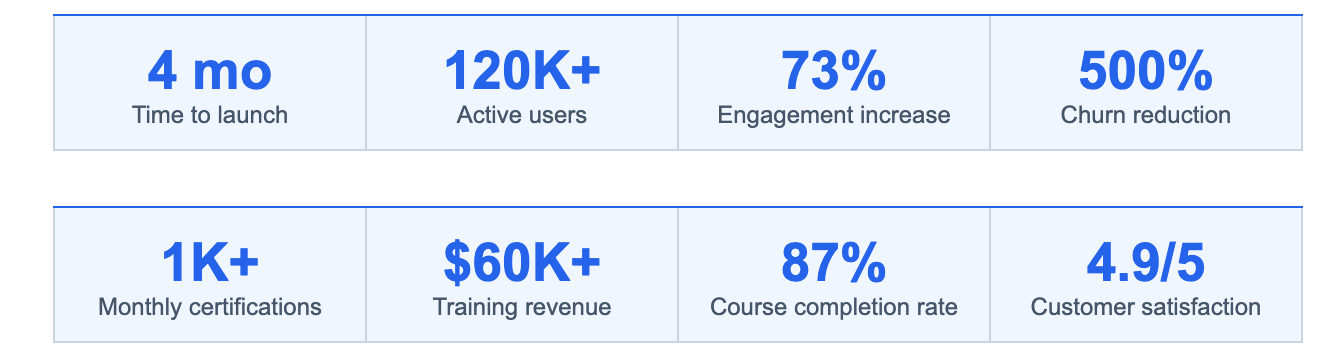
ClickUp University Results
The university also earned Skilljar's Golden Skillet Award for Innovation in Customer Education — an external validation of what the internal metrics already showed: this approach works.
Case Study 2: Planview AdaptiveWork Configuration Masterclasses via Kolme Group
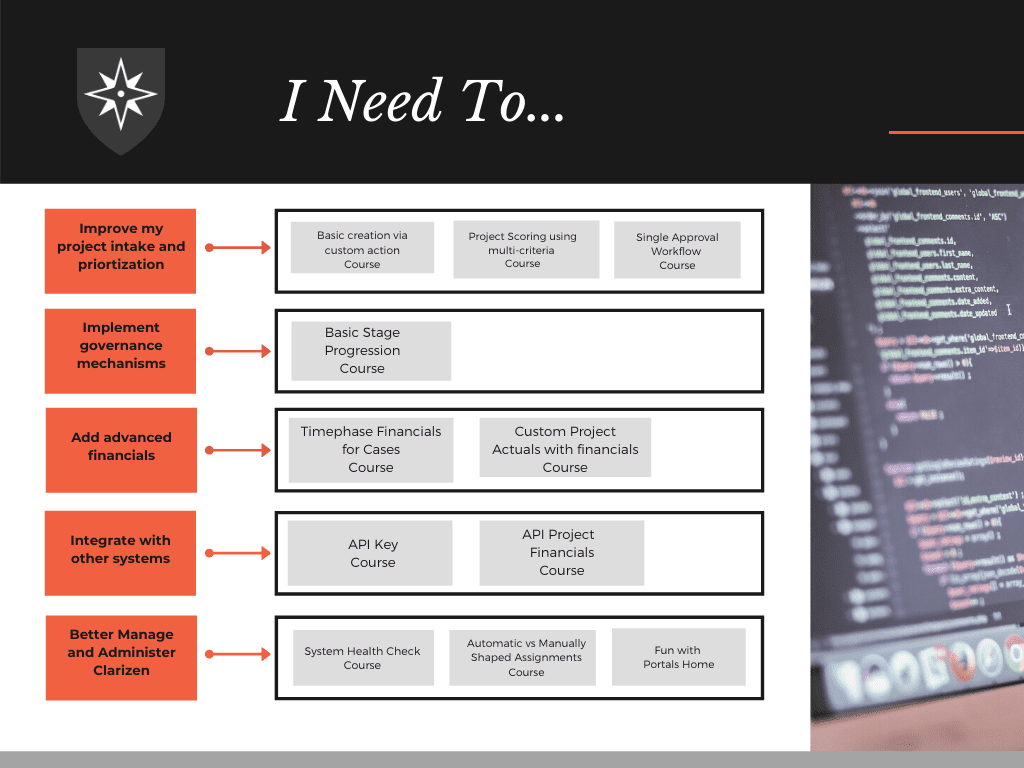
The second case study looks different in form but identical in principle. As lead education partner at Kolme Group, I designed, developed, and project managed the AdaptiveWork Configuration Masterclasses for Planview University — the only Expert-level, paid content available for advanced and Admin users of the platform.
This wasn't just content creation work. I was responsible for pricing strategy, placement within the broader university, and the ongoing partnership with Planview's internal training team. We met weekly to manage content currency, creation timelines, and brand updates — a process made significantly more complex when Planview acquired Clarizen (the original SaaS company that commissioned the coursework) and the brand identity changed entirely.
One of the most strategically meaningful decisions we made was identifying which courses to prioritize for multilingual translation — a move that opened the content to a genuinely global audience across English, Arabic, French, German, Chinese, and other languages.
The quality and reliability of that work led directly to Kolme Group becoming Planview AdaptiveWork's leading education partner, which then opened the door to a paid contract to overhaul the beginner onboarding pathway for new users. We delivered a completely redesigned pathway — new videos, new training content, and polished video editing — in under four months.

Planview University Overview
The Bottom Line
A Customer Education University is not a nice-to-have. It's not something you build when you've "figured everything else out." It is a core business strategy for any SaaS company that wants to retain its customers, grow its revenue, and build a brand that lasts.
The path is clear. The framework is proven. The results are real.
What it requires is intention, investment, and someone who knows how to execute. If you're thinking about building a customer university for your SaaS company — whether from the ground up or by elevating what already exists — I'd love to talk about what that could look like for your business.